
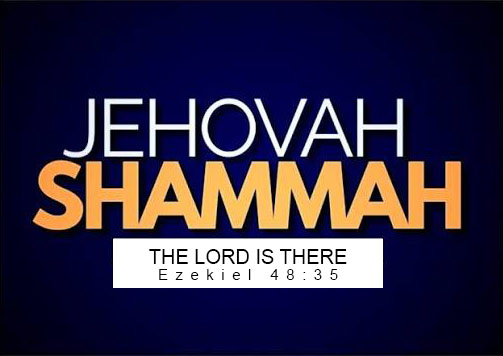
Text: Exodus 32:34-33:6; Ezekiel 48:35
It is said of David Livingstone, missionary to Africa that he returned to England for a brief visit towards the end of his life. He was honored by Queen Victoria and was asked to address the students at Cambridge University. Very simply and very quietly he said to them, “Gentlemen, shall I tell you what it was that kept me true to my resolve through all those years in the Dark Continent? It was the words of my Savior, “…lo, I am with you alway, even unto the end of the world. Amen.”
We learn from Exodus 32 that the Israelites, less than 40 days after having promised to keep the Law, have already sinned against the Lord by fabricating a molten calf (Ex 32). In His wrath, God declared to consume them and from Moses raise up a new nation (Ex. 32:7-10).
Moses intercedes on their behalf and gives the people an opportunity to repent when he said, “Who is on the LORD’S side? let him come unto me.” The Levites were the only ones who responded. Moses ordered the Levites to slay from among them those who would not stand with Moses, on the Lord’s side. The next day Moses went up to meet with the LORD to make atonement for the people. The Lord then orders Moses to take the people on to Canaan; however, He refuses to go up with them.
We learn from Ex. 32:34 and 33:1-3 that God assigned an Angel to go before them. Note again 33:3, “I will not go up in the midst of thee; for thou art a stiffnecked people: lest I consume thee in the way.”
Exodus 32 and 33 is the record, according to some, of Israel’s first national crisis. Notice a few notable highlights from Exodus 33.
Outline:
- MOSES RETREATS TO A TENT OF MEETING
When God said that His presence will not accompany His people to Canaan, two things happened.
- The people mourn (1-6). The nation had been guided by a pillar of cloud by day, and a pillar of fire by night. However, they have now provoked the Lord to anger, therefore God has now refused to accompany them on their journey to Canaan.
- Moses pitched a tent (7-11).
Moses pitched a tent, not the portable tabernacle from the pattern he had been given by God from Mt Sinai, for it will not be set up until chapters 35-40. This tabernacle or tent, however, was a temporal place to commune with God. Moses calls the tent, the “Tabernacle of the Congregation” meaning, the tent of meeting. This portable tent was set up “outside the camp” at some distance, where Moses and the people met with the Lord. God approved these arrangements by a pillar of cloud that descended from the top of Sinai and stood at the door of the tent, securing Moses’ privacy. At the sight of the cloud the people “worshipped,” at their own tent door, while Moses spoke with God “face to face, as a man would speak to his friend” (11).
- MOSES REFUSES TO GO UP TO CANAAN WITHOUT GOD (12-17)
Moses responds to God by presenting a case, an argument, or reasons why God must change His mind about not going before them to Canaan.
- Verse 12, Who will go with me? You know my name, but I don’t know who will go with me to Canaan.
- Verse 13, If I have found grace in your sight show me your way that I may know you or know your way.
- Verse 14, God concedes, my presence shall go with you!
- Verse 15, Moses states, if you don’t go with us, then don’t make us go to Canaan.
- Verse 16, If you don’t go with us, how shall other nations know that we have found grace in thy sight? How shall Israel be known as God’s people? How will we be recognized as a peculiar people, a distinct nation? Without God’s presence Israel will not be distinguished from all other nations of the earth. An accompanying angel will not do for us what God’s presence can do. God’s presence, His divine provisions, and His mighty power sets His people apart from all other nations.
- Verse 17, God said, “I will do this thing also that thou hast spoken: for thou hast found grace in my sight, and I know thee by name.”
Ezekiel 40-48 describes a future city during the thousand-year reign of Christ. In the final verse of chapter 48, the city is called Yahweh-shammah, which means the Lord Is There. Ezekiel 48:35, “It was round about eighteen thousand measures: and the name of the city from that day shall be, The LORD is there.”
Has the Lord abandoned you, or has His presence departed from America? Sometimes it appears as though He has, perhaps, for the same reason He abandoned Israel in Exodus 33. Perhaps, it’s time to seek the Lord in a “tent of meeting.”
- MOSES REQUESTED TO SEE THE GLORY OF GOD (18-23)
Verses 18-23, “And he said, I beseech thee, shew me thy glory. And he said, I will make all my goodness pass before thee, and I will proclaim the name of the LORD before thee; and will be gracious to whom I will be gracious, and will shew mercy on whom I will shew mercy. And he said, Thou canst not see my face: for there shall no man see me, and live. And the LORD said, Behold, there is a place by me, and thou shalt stand upon a rock: And it shall come to pass, while my glory passeth by, that I will put thee in a clift (cleft) of the rock, and will cover thee with my hand while I pass by: And I will take away mine hand, and thou shalt see my back parts: but my face shall not be seen.”
Someone said, “Moses had already been permitted to a closer communion with God than any other man since Adam. Moses, witnessed a measure of the glory of God when God “descended in fire and smoke upon Mount Sinai in Ex 19:18. Moses witnessed the glory of God when he “went into the midst of the cloud” for 40 days in Ex 24:18. Moses, in the tent of meeting probably stood in the midst of the glory of God, when the Lord spoke to him as a man would speak to his friend. However, Moses wanted another glimpse. What he had seen created an appetite for more.
Why? Not sure! Perhaps for the reassurance of His presence. Whatever the reason, God consented. The Bible says that no man shall see the unveiled glory of God and live, therefore God told Moses that he will see all that can be seen of God, however, more than he has ever seen of God. Moses shall see the evidence of God’s presence when all His goodness shall pass before him.
Moses shall be placed in the cleft of a rock and covered with God’s hand, however God will take away his hand when he passes by Moses, so he can see as much as mortal man can withstand. Moses shall be permitted to see the backside or back parts of Jehovah-Shammah, but His face shall not be seen.
The Hebrew word for face (33:20) is often translated presence in the O.T. as in Ge 3:8, “And they heard the voice of the LORD God walking in the garden in the cool of the day: and Adam and his wife hid themselves from the presence of the LORD God amongst the trees of the garden.
The back parts or the shadow of His back parts or a shadow of His glory, or the evidence of the presence of God, or God’s glory in part was all that Moses could withstand.
Closing:
- Every child of God, especially leaders, need to visit a Tent of Meeting regularly.
- Is it possible to reach the borders of Canaan without a “tent of meeting” the place from which we seek the presence of God and a glimpse of His glory?
Leave a Reply